Lutetium-177 PSMA: a new targeted therapy for advanced prostate cancer
2026-06-18
Lutetium-177 PSMA Therapy for Advanced Prostate Cancer: What the Method Is and Who It May Help
Metastatic prostate cancer cannot always be controlled for long with standard treatment. In some patients, the disease eventually stops responding to hormone therapy. This stage is called metastatic castration-resistant prostate cancer. In recent years, one of the treatment approaches being increasingly used for this group of patients is Lutetium-177 PSMA radioligand therapy.
This is not “whole-body radiation” and it is not conventional chemotherapy. The method belongs to targeted radionuclide therapy: a radioactive substance is delivered mainly to tumor cells that carry a specific molecular target.
What Is PSMA?
PSMA stands for prostate-specific membrane antigen. It is a protein often found on prostate cancer cells, especially in advanced disease.
This feature is used in two ways:
- For diagnosis — PSMA PET can help detect tumor sites more accurately.
- For treatment — a radioactive isotope, such as Lutetium-177, is attached to a molecule that recognizes PSMA.
This approach is known as theranostics: the same biological target helps both to visualize the tumor and to treat it.
How Lutetium-177 PSMA Therapy Works
In ¹⁷⁷Lu-PSMA therapy, the patient receives a radioligand — a molecule that binds to PSMA on the surface of tumor cells. After binding, the complex is taken up into the cell. Lutetium-177 emits beta radiation, which damages the tumor cell and may trigger its death.
The main idea of the method is to deliver radiation closer to cancer cells while reducing damage to surrounding healthy tissues. For this reason, the therapy is considered more targeted than many traditional systemic treatments.
When This Therapy May Be Considered
In the source material, Lutetium-177 PSMA therapy is discussed mainly for patients with metastatic castration-resistant prostate cancer.
This is a stage in which:
- prostate cancer has already spread to distant sites;
- the disease continues to progress despite testosterone suppression;
- modern hormonal agents and chemotherapy may already have been used;
- additional treatment options are needed.
It is important to understand that the decision to use this therapy is not made based on the name of the method alone. It usually requires a multidisciplinary team. Doctors consider the extent of the disease, previous treatments, the patient’s general condition, kidney function, blood test results, and PSMA imaging findings.
Why the Method Has Spread Rapidly
According to the German population-based analysis, the adoption of ¹⁷⁷Lu-PSMA therapy increased rapidly. In Germany, the number of treatment cycles rose from 1,026 in 2016 to 3,328 in 2020. In total, 12,553 therapy cycles were recorded between 2016 and 2020.
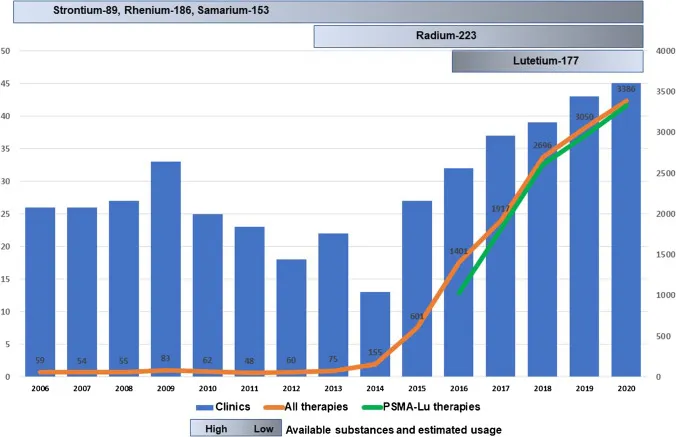
The orange line indicates the total number of all performed therapies per year. The green line indicates the total number of performed 177Lu-PSMA RLT per year. The blue columns represent the number of clinics providing the therapy. The grey columns show the available substances chronologically and their estimated usage (Source: Destatis database)
At the same time, the number of nuclear medicine departments offering this treatment also increased: from 25 departments in 2016 to 44 departments in 2020.
This reflects an important trend: the method gradually moved from limited use in selected large centers to broader clinical practice. However, the treatment remained highly specialized and was performed in nuclear medicine departments.
Where the Treatment Is Performed
In the German data, the therapy was performed exclusively in nuclear medicine departments. At the beginning of the analyzed period, most procedures were carried out in university hospitals: 88% in 2016. By 2020, the share of university hospitals had decreased to 70%, but they still remained the main centers providing this treatment.
This is expected for complex radionuclide therapy. It requires:
- nuclear medicine specialists;
- radiation safety procedures;
- experience with radiopharmaceuticals;
- the ability to monitor the patient after administration of the drug;
- cooperation between oncologists, urologists, radiologists, and nuclear medicine physicians.
What Is Known About the Patients Who Received Therapy
Most patients treated with ¹⁷⁷Lu-PSMA therapy in Germany were older than 65. Their share was 78% in 2016 and 81% in 2020.
This reflects real clinical practice: prostate cancer is more common in older men, and metastatic castration-resistant disease usually develops after several lines of treatment.
However, age alone is not the only criterion. The patient’s overall condition, disease activity, blood counts, organ function, and the presence of PSMA-positive lesions are usually more important when selecting treatment.
How Treatment Is Usually Given
The exact treatment schedule depends on the clinical protocol and the patient’s condition. In most cases, therapy is given in cycles: the patient receives several administrations of the drug at intervals.
In the German analysis, the median hospital stay was 3 days. This was related to radiation safety requirements and the handling of open radionuclides. The organizational model may differ between countries: in some healthcare systems, hospitalization is required; in others, outpatient treatment may be possible if regulations allow it.
Safety and Tolerability
In the German population-based analysis, in-hospital mortality among ¹⁷⁷Lu-PSMA therapy cases between 2016 and 2019 was 0.2%. Blood transfusion was required in 4% of patients.
These figures do not mean that the therapy is risk-free. Radioligand therapy may affect blood formation, salivary glands, kidneys, and general well-being. For this reason, blood tests and organ function are usually monitored before treatment and between cycles.
Overall, the presented data support the view that the method may be feasible in carefully selected patients, including older patients.
How This Method Differs From Conventional Radiation Therapy
In conventional external beam radiation therapy, the radiation source is outside the body, and the beam is directed at a specific area. In radioligand therapy, the radioactive drug is administered into the body and accumulates in cells that carry the target.
This makes ¹⁷⁷Lu-PSMA therapy especially relevant in metastatic disease, when there are multiple tumor sites in different parts of the body. The method allows systemic treatment while using the molecular selectivity of PSMA.
Why PSMA Imaging Is Important Before Treatment
If tumor lesions do not accumulate a PSMA ligand, Lutetium-177 PSMA therapy may be less effective. Therefore, imaging is usually needed before treatment to assess how strongly the tumor sites express PSMA.
In other words, doctors first need to confirm that the tumor has the “target” to which the therapeutic drug can attach.
What to Discuss With the Doctor
Patients and their relatives may want to clarify the following points in advance:
- whether metastatic castration-resistant prostate cancer has been confirmed;
- which previous treatment lines have already been used;
- whether PSMA PET or another appropriate imaging test has been performed;
- how strongly the tumor lesions accumulate the PSMA-targeted tracer;
- what the expected treatment goals are: disease control, symptom relief, delayed progression;
- which risks are most relevant for this specific patient;
- how many cycles are planned and how the treatment effect will be assessed;
- which blood tests and follow-up examinations are needed before and after therapy.
Limitations of the Data
The source material is based on an analysis of German administrative and hospital data. Such data are useful for understanding the scale of adoption: how many procedures were performed, where they were carried out, and how access to treatment changed over time.
However, these databases have limitations. They do not include detailed clinical information for each patient, such as PSA level, Gleason score, exact tumor burden, imaging results, or individual response to treatment. Therefore, these data should not be interpreted as a personal prognosis for an individual patient.
Key Takeaways
¹⁷⁷Lu-PSMA therapy is a modern form of targeted radionuclide therapy for patients with advanced prostate cancer, especially at the stage of metastatic castration-resistant disease.
The method is based on targeting PSMA, a molecular marker often found on prostate cancer cells. The therapeutic radioligand delivers Lutetium-177 to tumor cells and produces local radiation damage.
The German experience from 2016 to 2020 shows rapid adoption of this approach: the number of procedures increased, more centers began offering the therapy, and treatment gradually became available beyond the first university hospitals. At the same time, the therapy remains highly specialized and requires careful patient selection.
Source
Flegar L., Thoduka S.G., Librizzi D. et al. Adoption of Lutetium-177 PSMA radioligand therapy for metastatic castration resistant prostate cancer: a total population analysis in Germany from 2016 to 2020. European Journal of Nuclear Medicine and Molecular Imaging. 2023;50:2188–2195. DOI: 10.1007/s00259-023-06139-x.
This material is for informational purposes only and does not replace consultation with an oncologist, urologist, or nuclear medicine specialist.