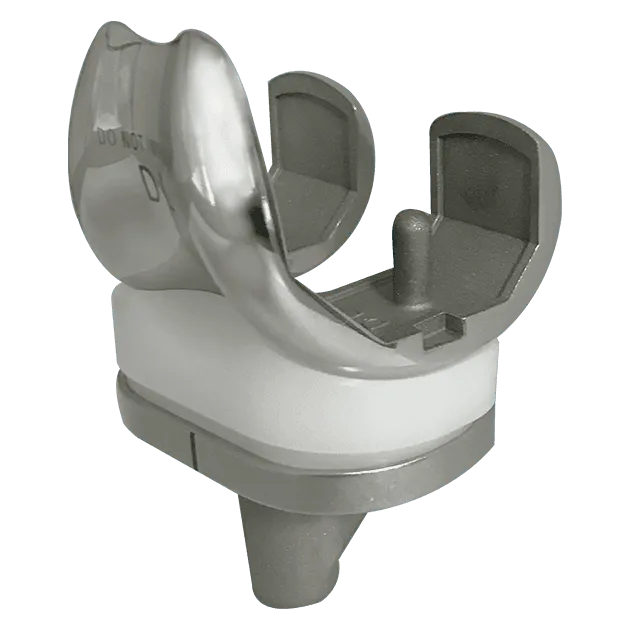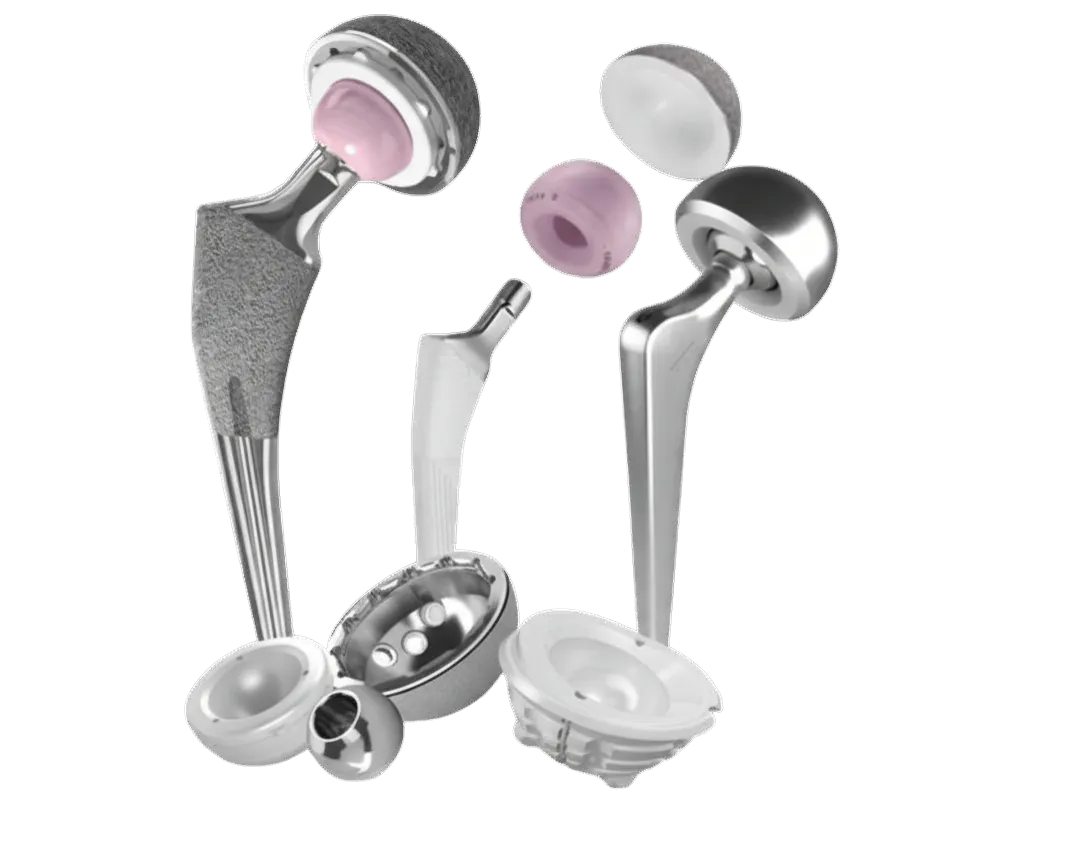
Latitud™ Hip Arthroplasty System
The Latitud™ Hip Arthroplasty System is a comprehensive solution for total and partial hip arthroplasty. The system provides surgeons with a choice of cemented and cementless fixation options and combines clinically established implant concepts with advanced bearing materials to support accurate restoration of hip joint biomechanics.
Key feature: modular component selection concept
The Latitud™ system is designed as a modular solution for total hip arthroplasty. The product range includes cementless, cemented, and bipolar components, allowing the implant configuration to be selected according to the patient’s anatomy, bone quality, and chosen surgical approach.
A unified instrument set helps standardize the surgical steps and simplifies handling of the system components.
Biomechanics of cementless fixation
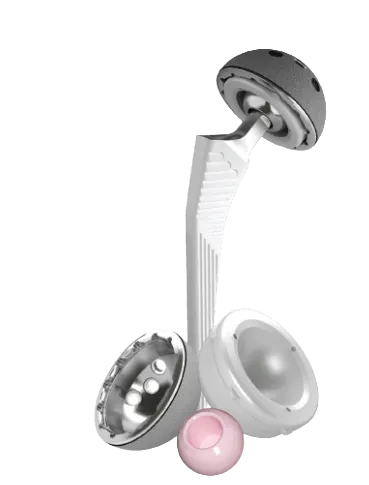
The design of the cementless components is intended to achieve primary stability and create conditions for subsequent osseointegration.
- Press-fit concept of the acetabular cup: the hemispherical shape with a flat base is designed for tight interference fit and distribution of apical load.
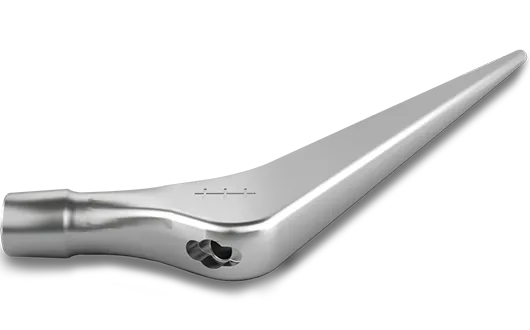
- Double-tapered trapezoidal stem: the stem geometry helps resist axial and torsional displacement, supporting rotational stability of the implant within the femoral canal.
- Round-trapezoidal neck geometry: the design is intended to reduce the risk of impingement and component contact across a wide range of motion.
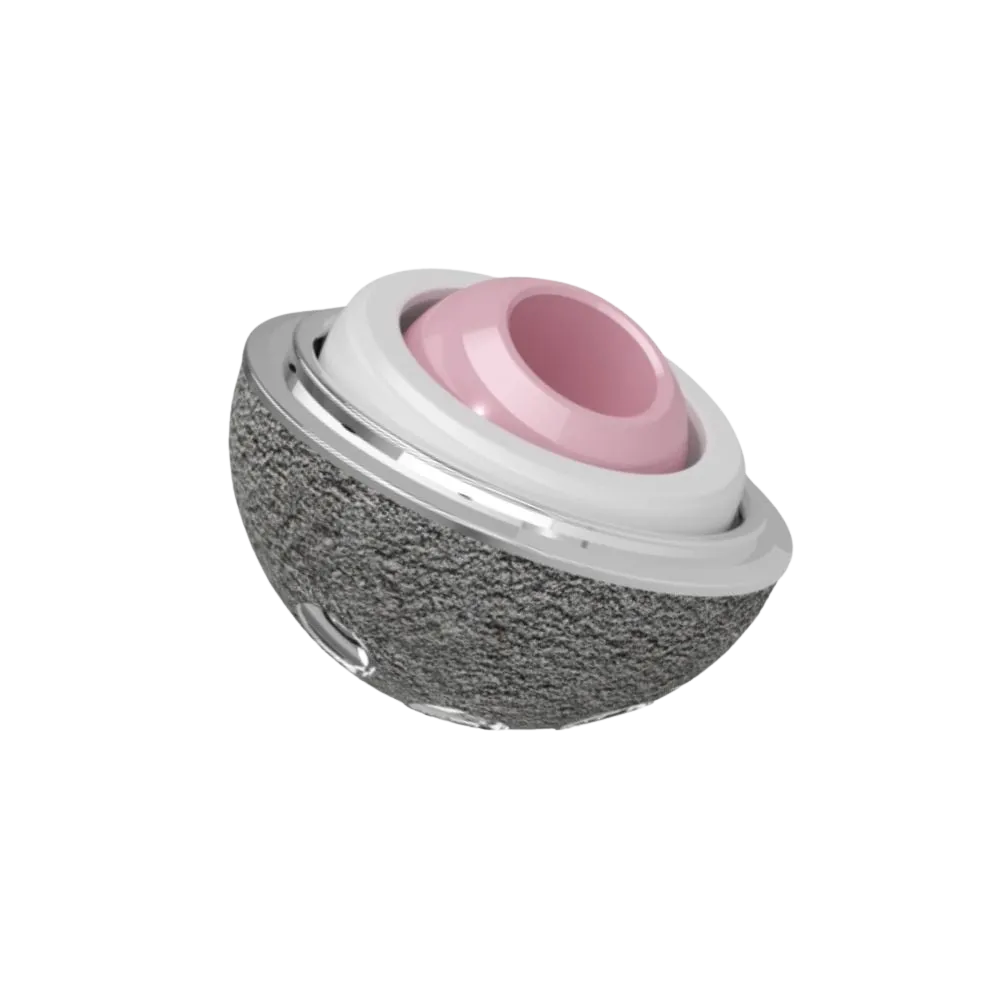
- Multi-level liner fixation: ETST technology with the Taper Lock taper-locking mechanism provides liner fixation within the cup and is intended to reduce micromotion.
Cemented solutions
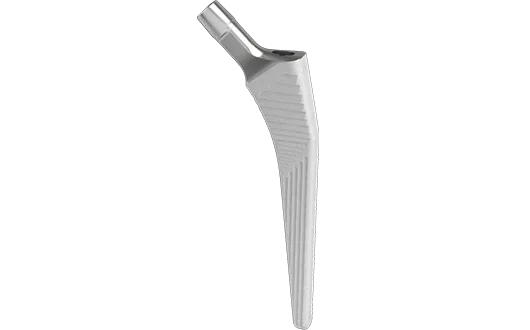
For patients with reduced bone quality, the system includes cemented components with geometry designed for stable fixation within the cement mantle.
- Self-locking tapered geometry: the polished double-tapered stem design contributes to radial compressive loading. Implant subsidence at the stem–cement interface is intended to support fixation stability.
- Hollow centralizer: helps position the stem correctly within the cement mantle and promotes even cement distribution while reducing end-bearing pressure.
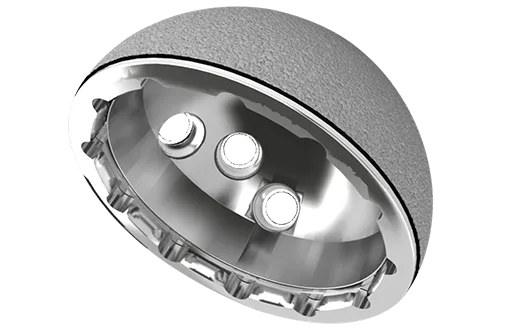
- Cemented cups with spacers: projections on the cup help center the component in the acetabulum and support formation of a cement mantle of the intended thickness.
Bearing materials and wear resistance
The Latitud™ system uses materials intended to reduce component wear and decrease the risk of wear-particle generation.
- BIOLOX® Delta ceramic heads: mixed oxide ceramic with high strength and wear resistance. The material does not include a metal bearing surface and is not associated with metal ion release from the head.
- HXLPE highly cross-linked polyethylene liners: highly cross-linked polyethylene is intended to reduce wear compared with standard UHMWPE.
- Osprovit® coating: hydroxyapatite coating on cementless stems is intended to support secondary biological fixation through bone integration.
- Porous titanium coating: used on cementless cups to create a surface that supports integration with bone tissue.
Design features for surgical technique
- Low-profile lateral shoulder: the design of the femoral components may be applicable for minimally invasive surgical techniques, where supported by the surgical technique and manufacturer’s instructions.
- Reduced distal profile: facilitates insertion and placement of the femoral stem and may reduce the risk of intraoperative bone damage.
- Polished rim of the cementless cup: intended to reduce the risk of soft-tissue contact and irritation of the iliopsoas muscle.
Indications and areas of use
- Non-inflammatory degenerative joint diseases: osteoarthritis, post-traumatic arthritis, avascular necrosis.
- Rheumatoid arthritis.
- Acute traumatic fractures of the femoral neck or femoral head.
- Congenital hip dysplasia.
- Correction of functional deformities.
- Revision surgery in cases of failed previous arthroplasty.
Materials used
- Cementless stems and modular cups: forged biocompatible titanium alloy Ti-6Al-4V ELI with high fatigue strength.
- Cemented stems: high-nitrogen high-strength stainless steel.
- Femoral heads: BIOLOX® Delta ceramic or cobalt-chromium alloy.
- Liners: highly cross-linked polyethylene HXLPE and ultra-high-molecular-weight polyethylene UHMWPE.
System components
- Cementless femoral stems: standard, lateralized, and specialized options for Coxa Vara.
- Cemented femoral stems with a size range and offset options.
- Stems with proximal coating.
- Modular cementless acetabular cups with holes for additional screw fixation.
- Cemented acetabular cups: standard, low-profile, and anatomically inclined.
- Modular polyethylene liners.
- Modular femoral heads in various diameters.
- Bipolar monoblock cups for hemiarthroplasty.
- Bone screws, centralizers, and cement restrictors.
Certification and safety
- Components are supplied in individual sterile packaging. The sterilization method — gamma irradiation or ethylene oxide — depends on the material and component type.
- Cemented versions of the system are equipped with radiopaque markers for postoperative assessment of implant position.